

Total
HK$0.00


Key Points
- Clarify your primary learning goal (career, business, teaching, or interest) before choosing a school.
- Evaluate academies using 8 key criteria, including focus, pricing transparency, facilities, and class hours.
- Beginners should prioritize small paired classes, dedicated job placement, and CEF subsidy eligibility.
- Beware of short crash courses and hidden fees; always tour the campus and review refund policies.
- Compare multiple schools and check authentic online reviews to find the best fit for your needs.
Summary
This 2026 Hong Kong beauty academy guide breaks down 8 key evaluation criteria to help beginners avoid traps and pick the best school.
FOAMMALL | Lifestyle and Trends Column
Hong Kong Beauty School Selection Guide 2026 | 8 Practical Evaluation Criteria + Institutional Reference List — A Must-Read for Beginners
FOAMMALL Editorial Note: This article is a consumer reference guide for the Hong Kong beauty training market. It covers school selection methods and institutional comparisons for Hong Kong readers only. FOAMMALL does not provide any educational or training services and does not recruit students from Mainland China. All institutional information is sourced from publicly available 2026 data. Readers should verify the latest details with the respective institutions before enrolling.
Introduction: The First Step Is Not "Which School Is the Best"
Many people, when first looking for beauty courses, ask: "Which beauty school in Hong Kong is the best?" But this question itself misses the point. There is no single "best" beauty school in the world — only the one that best fits your personal needs.
Today, Hong Kong's beauty training market is a mixed bag. There are established schools with over a decade of experience in beauty and aesthetic education, and there are general vocational centers that offer everything from beauty to cooking, treating beauty as just one of many revenue streams. Advertisements are everywhere, tuition fees range from a few thousand to tens of thousands of dollars, and it's nearly impossible to tell the genuine from the flashy just by looking at the marketing.
Below, we've compiled 8 practical evaluation criteria — from "institutional focus" to "online reputation" — with step-by-step guidance on what to check, where to check, and how to judge. A reference list of Hong Kong's major beauty schools and a pre-enrollment checklist are also included. Follow these steps, and you won't be fooled by fancy packaging.
Part 1: Clarify Your Own Needs Before Comparing Schools
Before you start comparing schools, take a moment to answer the following 5 questions. Write down your answers — they'll serve as your weighted priorities when applying the evaluation criteria:
Question 1: What is your ultimate goal for studying beauty?
- Full-time career as a beautician: Look for schools with internationally recognized qualifications, sufficient practical hours, and job placement support.
- Starting your own studio or freelance work: Pay attention to entrepreneurship support and the depth of high-value modules (semi-permanent makeup, laser aesthetics).
- Becoming a beauty instructor: Choose institutions that offer instructor certification and teaching practice opportunities.
- Personal interest or self-use: Short-term hobby courses are sufficient — no need to obsess over accreditation or employment support.
Question 2: What is your budget?
- Tight budget: Prioritize HKQF-accredited courses eligible for CEF funding (up to 80% tuition reimbursement).
- Comfortable budget: Consider internationally recognized certifications like VTCT, ITEC, or CIDESCO for broader recognition.
- Special reminder: Advertised prices are not final prices — always ask for a "full package" breakdown to avoid hidden fees.
Question 3: How much time can you commit?
- Full-time availability: Intensive full-time courses can be completed in a few months — ideal for those eager to enter the industry quickly.
- Working while studying: Look for evening or weekend sessions — slower progress but no need to quit your job.
- Special reminder: Don't fall for 2 to 3 day "crash courses." Beauty is a craft — skills take time to develop. Crash courses only teach the bare minimum.
Question 4: What learning environment do you prefer?
- Individual attention: Classes under 10 students are ideal — the smaller the class, the more hands-on guidance you'll receive.
- Peer interaction: 15 to 20 students per class is acceptable.
- Lots of hands-on practice: Confirm that the school offers "paired practice" sessions where students practice on each other.
Question 5: What kind of post-graduation support do you need?
- Job referrals: Verify there's a dedicated placement department — don't just take "we offer job support" at face value.
- Continuing education: Choose schools with regular workshops and alumni discounts for refresher courses.
- Entrepreneurship: Look for startup consulting and industry resource connections.
Part 2: 8 Practical Evaluation Criteria (Step-by-Step Breakdown)
Once you've clarified your needs, you can systematically evaluate each candidate school. The following 8 criteria each include "checkpoints, verification channels, and judgment indicators." Just follow the steps.
Criterion 1: Academic Focus — Is Beauty Their Sole Mission?
Why it matters: A school that focuses exclusively on beauty and aesthetic education will invest all its resources — faculty, equipment, facilities, and industry connections — into this field. If a school offers everything from beauty to cooking, real estate, accounting, and security training, beauty is just one of many business lines, and they won't invest deeply in optimizing beauty education.
Checkpoints:
1. What percentage of the curriculum is beauty and aesthetic-related?
2. Are all instructors from the beauty industry? Are any from unrelated fields?
3. Are all campus facilities dedicated to beauty training? Are there kitchens, computer labs, or security training areas?
4. Are partner organizations beauty-related (salons, medical aesthetic centers, cosmetic brands, industry associations)?
Verification channels: School website (course pages and faculty pages), request an on-site visit, directly ask admissions counselors: "Besides beauty, what other courses do you offer?"
Judgment indicators:
Ideal: 90% or more of courses are beauty or aesthetic-related; all instructors are experienced industry professionals; campus is filled with beauty equipment and treatment beds.
Caution: If beauty courses are just a small part of the catalog and the rest are unrelated vocational programs, question their commitment.
Avoid: If admissions counselors rattle off a long list of non-beauty courses when asked "what else do you offer," they're not a focused beauty school.
Criterion 2: Pricing and Integrity — Is This an Honest School?
Why it matters: The beauty training industry has its share of hidden fees, forced product purchases, and exaggerated job promises. An honest school will be transparent about everything — they won't shy away from scrutiny or comparison.
4 Integrity Litmus Tests:
1. Hidden fees: Is the advertised price final? Are materials, equipment usage, exam, and certification fees included? Are there any additional charges later?
2. Forced product purchases: Do instructors constantly push their own branded products? Is "buying products" tied to "passing" or "graduation"?
3. Pass rate transparency: What are the historical pass rates? Can they provide real data?
4. Clear refund policy: Is there a written refund policy? Under what circumstances can you refund? How much? What's the process?
Verification channels: Request a written fee breakdown and refund policy; observe whether instructors spend excessive time promoting products during class; search online for complaints about hidden fees or forced purchases; ask directly: "If I want to withdraw mid-course, how much can I get back? What's the process?"
Judgment indicators:
Ideal: Fees are clearly stated in writing; instructors focus on teaching, not selling; real pass rates are published; refund policy is clear and reasonable.
Caution: If admissions counselors are evasive about fees and only reveal details when pressed, be wary.
Avoid: Schools that claim "100% pass" or "100% job placement" but can't provide evidence; those that rush you to sign contracts without allowing proper review.
Criterion 3: Facilities and Equipment — Do They Have Enough Resources to Teach You Well?
Why it matters: Beauty is a hands-on industry. Sufficient teaching space and adequate equipment directly affect each student's practice opportunities. If 15 to 20 students are crammed into a small room, each queuing for one machine, practice time will be severely limited.
Checkpoints: How many students per class? (10 or fewer is ideal, even-numbered pairs are best); Are there dedicated practice areas for different courses?; Are equipment quantities sufficient?; Are machines professional brands or off-brand?; Are disinfection facilities adequate?
Judgment indicators:
Ideal: Even-numbered small classes under 10 students; dedicated practice areas for each course; sufficient professional-grade equipment; clean environment with proper disinfection.
Avoid: Overcrowded classrooms with 20 or more students; long queues for equipment; insufficient machines; messy environment.
Criterion 4: Course Hours — Do They Give You Enough Time to Learn?
Why it matters: Beauty is a craft — skills take time to develop. In a 2 to 3 day crash course, after deducting theory and demonstrations, students may only get a few hours of actual practice. That's simply not enough to master the techniques, and graduates won't feel confident taking on clients.
Recommended Minimum Hours by Course Type:
| Course Type | Minimum Hours | Coverage |
|---|---|---|
| Introductory Beauty Care | 60-100 hrs | Skin physiology, cleansing, moisturizing, basic facial care, disinfection |
| Nail Technology | 80-120 hrs | Nail care, Gel nails, nail art, extensions, foot care |
| Eyelash Extensions | 40-60 hrs | Lash structure, classic lash, YY lashes, lash lift, disinfection |
| Semi-Permanent Makeup | 80-120 hrs | Skin physiology, pigment theory, brow/eye/lip application, live practice, retouching |
| Laser and Light Aesthetics | 60-100 hrs | Laser principles, skin typing, equipment operation, safety protocols, contraindications |
| Media and Stage Makeup | 100-150 hrs | Makeup fundamentals, stage makeup, film/TV special effects, historical styling, hair design |
| International Diploma (e.g., VTCT Level 3) | 150-300 hrs | Comprehensive theory + extensive live practice + assessments + portfolio |
Criterion 5: Post-Course Activities — Do They Offer Opportunities to Apply Your Skills?
Why it matters: Skills learned in class are only truly internalized through real-world application. A good school won't cut ties after graduation — they'll continuously organize activities that allow graduates to participate, gain experience, and expand their networks.
Checkpoints: What post-course activities does the school regularly organize? (In-school competitions, community outreach, industry exhibitions, film/TV/stage makeup internships, graduate exhibitions, new technique workshops, entrepreneurship seminars); How often are activities held?; Are all graduates eligible, or is it limited to a select few?
Criterion 6: Job Placement Support — Do They Have a Real Platform to Help You Find Work?
Why it matters: Many people study beauty with the ultimate goal of entering the industry or starting a business. But for those changing careers from scratch, post-graduation challenges often include "not knowing where the jobs are," "having no industry connections," and "not knowing how to write a CV." A school with a dedicated placement department can solve these pain points.
Checkpoints: Does the school have a dedicated placement department?; How many employer partners are there? Which organizations?; Is there an internal job board?; Is there one-on-one CV optimization and interview coaching?; What is the historical graduate employment rate?
Criterion 7: Learning Resources — Do They Provide Post-Class Study and Improvement Support?
Why it matters: Class time is limited — you can't remember everything the instructor says. A professional beauty school should offer comprehensive post-class learning resources for review, gap-filling, and self-improvement.
Checkpoints: Is there a physical library?; Is there an online learning platform?; Are there recorded lectures for post-class review?; Are there online exam practice banks?; Can graduates continue to access these resources?
Criterion 8: Online Reputation — What Are People Really Saying?
Why it matters: A school can present a perfect image in its advertising, but real student reviews online are harder to fake. They reveal the actual teaching quality, service attitude, and pricing transparency.
Channel 1: Google Business Profile
Check overall rating and review count (50 or more reviews is more credible). Read 1-2 star negative reviews and see how the school responds — is the tone sincere?
Channel 2: Facebook Page Reviews
Check the recommendation rate (80-90% is reasonable). Look for reviews with photos and check reviewer profiles to assess authenticity.
Channel 3: Online Forums
LIHKG, Baby Kingdom, Hong Kong Discussion Forum, Xiaohongshu. Search for "School Name review / good or bad / scam".
Part 3: Hong Kong Beauty School Reference List (4 Major Institutions Compared)
After applying the 8 criteria above, here is a reference list of 4 major, reputable beauty schools in Hong Kong to serve as your starting point. Each has its own strengths — match them against your needs:
| School Name | Core Certification | Class Size | Placement Support | CEF Eligibility | Best For |
|---|---|---|---|---|---|
| LBEDU Luster Beauty International Education and Training Academy (Gov't Reg Institution Code: 854) |
VTCT + ITEC + HKQF + IQA Instructor Cert | 10 or fewer students, even-numbered pairs | Dedicated placement office + internal job board + 100+ employer partners + CV/interview coaching | All HKQF courses | Career changers from zero, those valuing international certification + job support + small classes, long-term development |
| Esther Academy | ITEC | 12-20 students | No systematic placement platform — only occasional referrals | Some courses | Those with some foundation seeking ITEC pathway |
| Frederique Academy | CIDESCO, ITEC, IQA | 15-25 students | Only a few partner referrals | Limited subjects | Those with higher budget, prefer premium environment |
| FIA Academy (Medical Aesthetic Group Affiliate) |
Group-specific certificate | 15-30 students | Only internal group positions | Not eligible | Those committed to joining that specific group only, no other options |
Summary Recommendations
- Career changers from zero seeking quick industry entry: Prioritize LBEDU — small even-numbered classes with paired practice ensure solid skills; placement office + internal job board + 100+ employers provide strong job support; all HKQF courses are CEF-eligible.
- Those with existing beauty foundation seeking advanced IQA certification: Consider Frederique Academy, but note larger class sizes and limited placement support.
- Those committed to a specific medical aesthetic group only: Consider FIA Academy, but note certification is only recognized within the group.
Part 4: Pre-Enrollment Final Checklist
Self-Needs Confirmation
- Clarified your goal (career/entrepreneurship/instructor/hobby)
- Determined budget and whether CEF funding applies
- Determined available study time (full-time/part-time)
- Understood preferred learning environment (small/large class)
8-Criteria Verification
- Focus: Beauty/aesthetic-only courses
- Transparency: No hidden fees, no forced product sales, clear refund policy
- Facilities: Visited the campus, class size reasonable, equipment adequate
- Hours and support: Total hours meet standards, high practical ratio, placement and learning resources available
Part 5: FAQ
Q1: How do I actually choose a good beauty school?
Follow the systematic approach in this guide: Step 1 — assess your own needs; Step 2 — use the 8 criteria to evaluate each candidate; Step 3 — use the final checklist for your decision. Don't just look at ads and fees — always visit the campus in person.
Q2: Are 2 to 3 day "crash courses" useful at all?
Generally, no. Beauty is a hands-on craft that requires sufficient theory and extensive live practice. Crash courses offer minimal hands-on time, and graduates often lack the confidence to take on clients — especially for invasive procedures that carry higher risks.
Q3: Which beauty courses qualify for CEF funding?
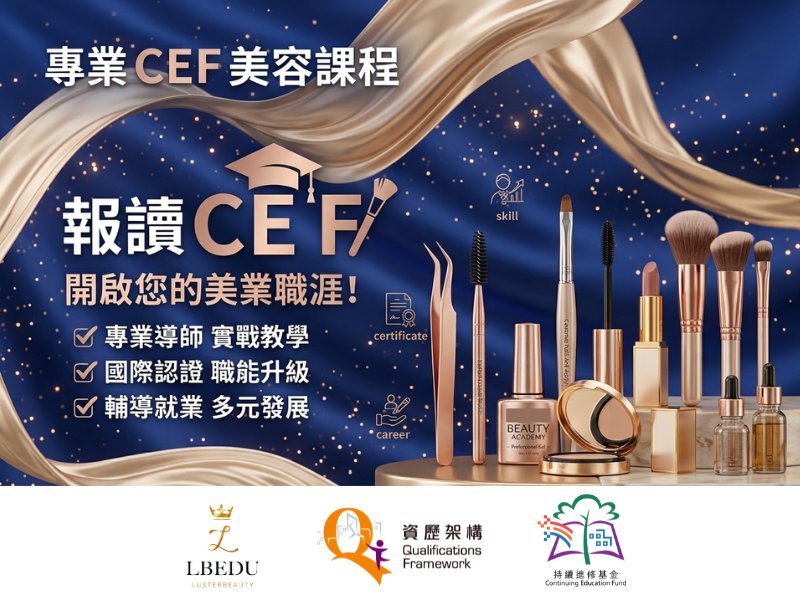
HKQF-accredited courses are eligible for the Continuing Education Fund (CEF), offering up to 80% tuition reimbursement (capped at HK$25,000). For example, all HKQF courses at LBEDU are CEF-eligible.
Q4: What must I do before enrolling in a beauty school?
Three things: 1. Visit the campus and observe classes in session; 2. Carefully read the contract (especially fee breakdown and refund policy); 3. Ask for all fee and hour details in writing — insist that promises are documented.
Conclusion
Choosing a good beauty school is the first and most crucial step on your beauty career path. A good school doesn't just teach you skills — it provides ongoing support and resources to help you grow and thrive in the industry.
Remember: there is no "best" school — only the one that's "best for you." Don't be fooled by flashy ads or low prices. Use a systematic approach to evaluate each option, and you'll find a school truly worth investing in.
Sources: 2026 official websites of each institution, Hong Kong Qualifications Framework (HKQF) public data, Continuing Education Fund (CEF) public information | Compiled by FOAMMALL
Frequently Asked Questions
Share this article

Comments (0)
No comments yet
Be the first to share your thoughts!
Leave a Comment